For the last few years, the federal Electric Car Discount has been doing most of the heavy lifting for EV adoption in Australia. By waiving Fringe Benefits Tax (FBT) on eligible electric cars under the Luxury Car Tax (LCT) threshold, novated leasing turned what used to be a pricey early-adopter choice into a pretty straightforward financial win for anyone on a salary.
That generous run is now winding down. Under the Federal Government’s changes announced in the 2026–27 Budget (moving through Parliament as the Treasury Laws Amendment (Tax Reform No. 4) Bill 2026), the full FBT exemption will tighten on 1 April 2027 and wrap up altogether on 1 April 2029:
- Until 31 March 2027: Eligible battery electric vehicles (BEVs) under the $91,661 LCT threshold stay 100% FBT-exempt. Any existing leases delivered before the cut-offs will be grandfathered.
- From 1 April 2027 to 31 March 2029: EVs priced at $75,000 or less keep the full FBT exemption. Anything between $75,000 and the LCT threshold drops to a 25% FBT discount.
- From 1 April 2029: The full exemption is gone for good, and all eligible EVs under the LCT threshold move to a permanent 25% FBT discount.
All of this is playing out while Australian drivers are still nursing whiplash from the servo. Conflict in the Middle East and disruptions around the Strait of Hormuz pushed petrol to $2.60 a litre back in March, forcing Canberra into a temporary 32-cent fuel excise cut between April and June. With the full 53.7-cent excise back in place since August, we’re still staring down volatile prices hovering north of $2.00 a litre.
So as the federal tax break shrinks, the big question for the Australian car market comes down to what happens at the bowser next.
Two Very Different Futures for the Car Market
| Factor | Scenario 1: Petrol Stays Expensive ($2.10–$2.50+/L) | Scenario 2: Petrol Drops Back (~$1.70–$1.85/L) |
|---|---|---|
| Novated Leases (2027–2029) | Buyers flock to sub-$75k EVs; fuel savings easily cushion the smaller tax break on pricier models. | Demand for $75k+ EVs drops sharply in 2027; buyers start cross-shopping hybrids and petrol SUVs again. |
| After April 2029 (25% Discount) | EVs still win on total running costs; pre-tax expenses and dodging the servo keep leases attractive. | The fortnightly pay-packet gap narrows; EV sales will depend heavily on lower upfront sticker prices. |
| Used Car Values | Thirsty petrol SUVs take a resale hit; 3-to-5-year-old ex-lease EVs stay in high demand. | Petrol and hybrid resale values hold up better; slower turnover across the private fleet. |
Scenario 1: Petrol stays painfully high
If ongoing instability in the Gulf keeps crude oil elevated and Australian bowsers stuck above $2.00 to $2.50 a litre, the FBT phase-down probably won’t slow the EV shift much at all. It will just change which EVs people are leasing.
Even back in December 2025, when petrol was sitting around $1.90 a litre, government modelling estimated a full EV saves about $26,500 in fuel over its life. With 2026’s spike prices, industry figures suggest an entry-level EV can save a typical driver (doing 15,000 kilometres a year) more than $4,600 a year compared to a similar petrol car.
If fuel stays that expensive, insulating your household budget from overseas oil shocks becomes a much bigger selling point than tax minimisation.
Between 2027 and 2029, we’ll likely see a rush into the sub-$75,000 bracket, where the full FBT exemption still applies and Chinese and Korean brands are already fighting hard on price. Even after 2029, when the discount drops to 25% across the board, a novated lease will still make sense: you’re still saving GST on the purchase price, skipping the 5% import tariff, and keeping your running costs predictable. The real losers here will be mid-to-large petrol cars, as second-hand buyers baulk at $140 weekly fill-ups.
Scenario 2: Fuel prices return to pre-conflict norms
If supply routes in the Middle East stabilise and unleaded settles back into a more familiar $1.70 to $1.85 range, the policy changes will have a much bigger impact.
Without that weekly sting at the servo, salaried buyers are going to look a lot closer at the exact fortnightly maths. From April 2027, losing the full FBT shield on cars between $75,000 and $91,661 will almost certainly trigger a rush of orders in late 2026 and early 2027, followed by a noticeable slump in luxury electric SUV sales.
The bigger test hits in April 2029. Dropping from a 100% FBT exemption to a 25% discount takes a serious bite out of the annual tax saving (which currently sits at up to $11,000 a year for higher-income earners). If petrol is relatively cheap and interest rates stay firm, plenty of middle-income earners will look at a novated lease quote and realise a good conventional hybrid—with a lower upfront price—comes out roughly even in their take-home pay. EV growth won’t grind to a halt, but carmakers won’t be able to lean on federal tax breaks anymore. They’ll have to win buyers on sticker price.
State Incentives and the Rooftop Solar Factor
The days of generous state cash rebates are mostly behind us. NSW, Victoria, Queensland, South Australia, Tasmania, and WA all wound up their direct purchase subsidies between 2023 and 2025. Still, state rules and home energy schemes are quietly doing a lot of work in the background:
- Cheaper rego and stamp duty: Several states still reward EVs through lower ongoing costs. Queensland puts EVs in the lowest rego tier (the same as a 1-to-3-cylinder car, around $293 a year) and offers a concessional 2% stamp duty rate up to $100,000. Victoria leaves EVs out of its luxury stamp duty bracket, the Northern Territory has extended free EV rego and stamp duty concessions until mid-2027, and the ACT’s emissions-based rego system saves zero-emission drivers hundreds of dollars a year.
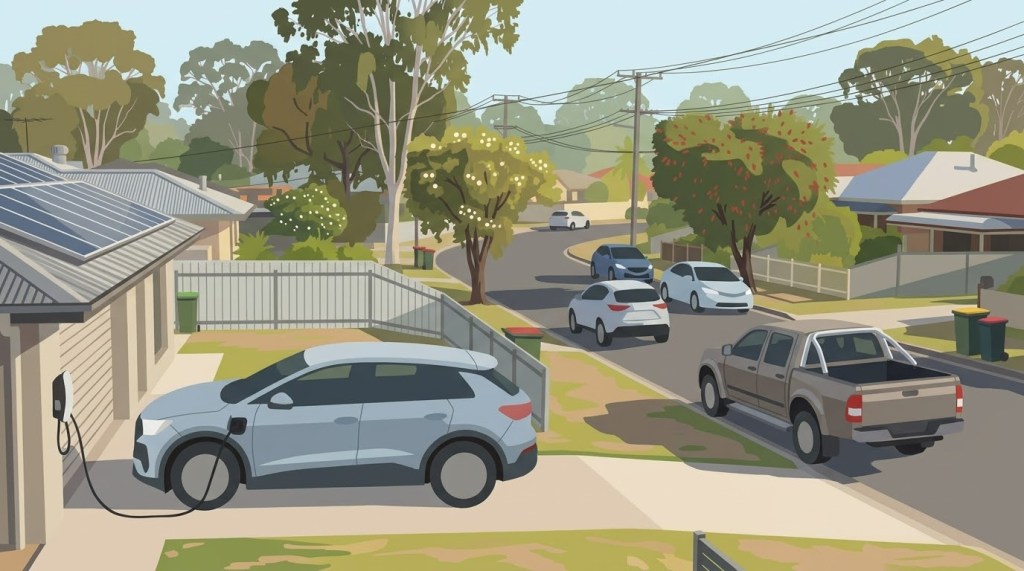
- The solar-and-battery advantage: Arguably the biggest driver of EV adoption in Australia isn’t a transport policy at all—it’s what’s sitting on our roofs. With schemes like the Cheaper Home Batteries Program knocking roughly 30% off upfront battery costs, and the ACT’s 3% Sustainable Household Scheme loans covering EVs and home chargers, more Aussies are pairing their cars with solar and storage. When you’re topping up your car from excess rooftop solar, your “fuel” cost is basically zero. That makes the maths stack up even if petrol drops back to $1.70.
Moving from Carrots to Sticks: Future Disincentives for Petrol Cars
As governments pull back on direct EV subsidies, the policy focus is already shifting from rewarding electric cars to making petrol and diesel vehicles harder to justify.
The New Vehicle Efficiency Standard (NVES) is already biting
Australia’s NVES kicked off in 2025, and the targets tighten fast. Passenger car fleet emissions limits drop from 141 g CO₂/km in 2025 to 117 g/km in 2026, and all the way down to 58 g/km by 2029. While the fines hit carmakers rather than buyers directly, brands that keep selling thirsty petrol SUVs, V8s, and diesel utes without enough EVs or hybrids to balance them out face hefty penalties. In the showroom, that means higher prices on big petrol models (we’ve already seen it with some large 4WDs) or certain variants being pulled from Australia altogether, while brands discount EVs to earn compliance credits.
Emissions-based rego and stamp duty
The ACT has already ditched traditional weight-based rego in favour of an emissions-based model. With state budgets under pressure and net-zero targets to meet, it’s easy to see other states following suit. Instead of funding EV discounts out of state coffers, governments can make the system revenue-neutral by simply charging higher annual rego and stamp duty on high-emitting petrol and diesel cars.
The Road User Charge (RUC) question
Every litre of petrol brings in 53.7 cents of federal fuel excise, and that revenue pool shrinks every time someone switches to electric. After the High Court struck down Victoria’s state-based EV tax in 2023, federal and state treasurers agreed to work on a national road-user charging framework (though NSW still has a legislated 3.095 c/km EV charge sitting on the books for July 2027, even if it’s on shaky legal ground).
How Canberra designs a national RUC matters a lot. A flat per-kilometre tax aimed only at EVs would add around $370 to $450 a year for an average driver, eating into their running-cost advantage. On the other hand, if the government eventually replaces fuel excise with a universal distance-and-emissions charge across all cars, heavier, dirtier petrol and diesel vehicles would end up paying noticeably more per kilometre than lighter EVs.
Resale value and city access
Looking further into the 2030s, Australian cities could easily follow Europe and parts of Asia with higher CBD parking levies for combustion cars or low-emission inner-city zones. Even without new laws, the market itself will start penalising holdouts: as EVs become the default, petrol drivers face rising servicing costs and steeper depreciation when it’s time to trade in.
Where Does This Leave Aussie Drivers?
Winding back the FBT exemption is a sign that Australia’s EV market is growing up. If fuel prices stay stubbornly high, the transition will keep rolling along regardless, led by sub-$75,000 EVs and home solar. If petrol cools back down to pre-conflict levels, the 2027 and 2029 cut-offs will force a much sharper, more competitive market where carmakers—pushed along by the NVES—have to compete on retail price rather than tax breaks. Either way, between tightening efficiency rules and the likelihood of emissions-weighted state charges, sticking with a petrol car is only going to get more expensive from here.


Leave a Reply