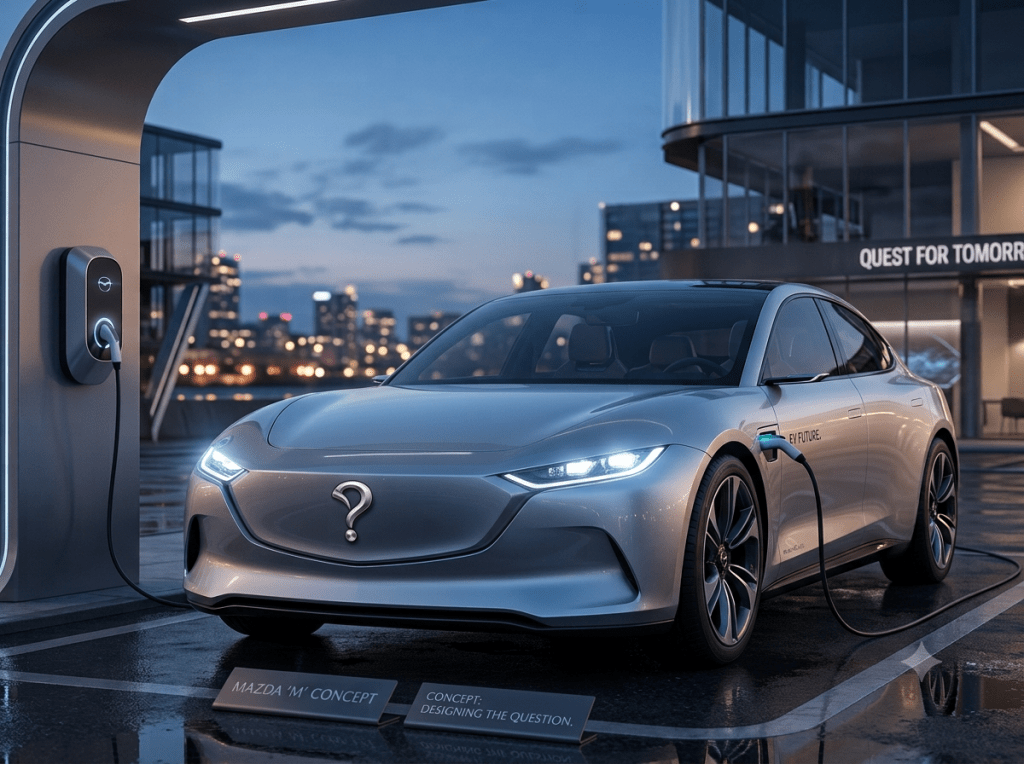
While most of the auto industry races to electrify, Mazda has spent the last few years doing something different: pumping the brakes. Executives have repeatedly questioned whether EV demand is as real as the headlines suggest, and the company has poured its energy into hybrids, rotary-powered plug-ins, and synthetic fuels instead. The question worth asking is whether that’s a principled long-term strategy — or a bet the company will come to regret.
What Mazda Has Actually Said
Mazda’s skepticism isn’t subtle. Back in late 2023, CEO Masahiro Moro told Fortune that EVs made up only around 6-8% of the US market, and that outside of Tesla, “other EVs are not taking off” while dealer inventory piles up. He framed the pace of the zero-emissions transition as something “up to consumer choice and social infrastructure” — a way of saying the market, not Mazda, would decide when this happens.
Two years later, at the 2025 Japan Mobility Show, CFO Jeff Guyton took a different angle. Rather than dismissing demand, he challenged the environmental case for EVs, arguing the industry fixates on tailpipe emissions while ignoring the full “well-to-wheel” carbon cost of building and powering a car. His pitch: put more attention into biofuels and hybrid technology, since those could reduce emissions across the billion-plus combustion cars already on the road, not just the new ones coming off assembly lines.
Instead of new EVs, Mazda’s showcase at Tokyo was two plug-in hybrid concepts — one built around its signature rotary engine. The message was consistent: Mazda calls this a “multi-solution” strategy, refusing to bet everything on one propulsion technology.
The Case That Mazda Is Wrong
Critics have been quick to point out the holes in this reasoning. Mazda’s own EV effort, the MX-30, was discontinued in several markets due to poor sales — but the MX-30 also had a notoriously small battery and short range compared to competitors. Blaming “the market” for a car that was undercooked to begin with is a hard sell.
There’s also the global picture. While EVs excluding Tesla may be struggling in some corners of the US market, brands like Kia, Hyundai, and BYD are selling electric vehicles at massive scale worldwide and racing to expand capacity. That suggests the problem isn’t that consumers don’t want EVs — it’s that consumers want good, competitively priced EVs, and Mazda hasn’t offered one yet.
Meanwhile, the well-to-wheel argument, while not wrong on the science, conveniently arrives from a company that hasn’t built the manufacturing base or battery supply chain to compete on EVs anyway. It’s difficult to separate “principled stance on lifecycle emissions” from “justification for being years behind.”
The Case That Mazda Might Be Right
Mazda isn’t alone in its hesitation — Toyota has made similar arguments for years, betting on hybrids and hydrogen alongside EVs rather than going all-in on batteries. There’s a real argument that a diversified approach hedges against uncertain charging infrastructure, volatile battery material costs, and regional differences in energy grids. In markets where electricity is still coal-heavy, the emissions math on EVs is genuinely less flattering than it looks in a Tesla commercial.
Mazda is also a small player. Committing billions to a dedicated EV platform is a much bigger gamble for a company Mazda’s size than it is for Toyota, GM, or Hyundai. A “wait and build smart” approach, if it means Mazda enters the market with a genuinely competitive product on a purpose-built platform (which reporting suggests is coming around 2027-2028 with its Skyactiv EV Scalable Architecture), could be a more survivable long-term play than being an early, unprofitable mover.
The Real Risk
The danger for Mazda isn’t skepticism itself — it’s timing. By the time Mazda’s dedicated EV platform arrives around 2027, competitors will have had close to a decade of production experience, battery cost reductions, and brand loyalty built up. Waiting to build the “right” EV only works if the company still has a seat at the table when it’s ready to sell it.
Mazda’s rhetoric about lifecycle emissions and consumer choice may be defensible in isolation. But it also reads, fairly or not, as a company rationalizing its own lack of readiness. Whether that’s a smart hedge or a slow-motion strategic mistake will depend entirely on whether Mazda’s eventual EVs are worth the wait — and whether customers are still around to buy them.


Leave a Reply